


 Cart
Cart
 sales@molnova.com


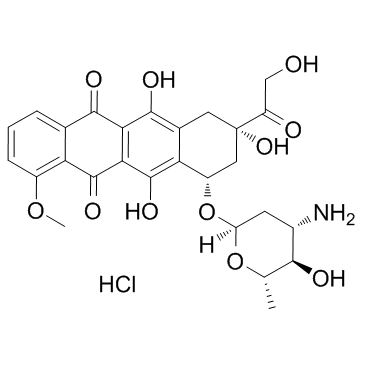
Epirubicin hydrochloride
CAS No. 56390-09-1
Epirubicin hydrochloride( 4’-Epidoxorubicin )
Catalog No. M15051 CAS No. 56390-09-1
Epirubicin hydrochloride, a semisynthetic L-arabino derivative of doxorubicin, is an antineoplastic agent by inhibiting Topoisomerase.
Purity : >98% (HPLC)
 COA
Datasheet
HNMR
HPLC
MSDS
Handing Instructions
COA
Datasheet
HNMR
HPLC
MSDS
Handing Instructions
| Size | Price / USD | Stock | Quantity |
| 2MG | 30 | In Stock |


|
| 5MG | 46 | In Stock |
|
| 10MG | 73 | In Stock |
|
| 25MG | 138 | In Stock |
|
| 50MG | 227 | In Stock |
|
| 100MG | 308 | In Stock |
|
| 500MG | 744 | In Stock |
|
| 1G | Get Quote | In Stock |
|
Biological Information
-
Product NameEpirubicin hydrochloride
-
NoteResearch use only, not for human use.
-
Brief DescriptionEpirubicin hydrochloride, a semisynthetic L-arabino derivative of doxorubicin, is an antineoplastic agent by inhibiting Topoisomerase.
-
DescriptionEpirubicin hydrochloride, a semisynthetic L-arabino derivative of doxorubicin, is an antineoplastic agent by inhibiting Topoisomerase.(In Vitro):Epirubicin hydrochloride (4'-Epidoxorubicin hydrochloride), like doxorubicin, exerts its antitumor effects by complex with DNA, resulting in damage to DNA and interference with the synthesis of DNA, RNA, and proteins. Epirubicin hydrochloride may also affect the integrity and activity of cellular membranes. Maximal cell kill caused by Epirubicin hydrochloride occurs during the S phase of the cell cycle. With higher concentrations effects are also seen in early G2 as well as G1 and M phases.Epirubicin hydrochloride display antineoplastic activity against most cancer cells. Epirubicin hydrochloride is cytotoxic to Hepatoma G2 cells with IC50 of 1.6 μg/mL at 24 hr. 1.6 μg/mL Epirubicin hydrochloride induces apoptosis of Hep G2 cells, and higher activity of catalase by 50%, Se-dependent glutathione peroxidase by 110%, Cu, Zn-superoxide dismutase by 172% and Mn-superoxide dismutase by 135%. Epirubicin hydrochloride increases the cellular expression of NADPH-CYP 450 reductase, and reduces GST-π expression.(In Vivo):Epirubicin hydrochloride (4'-Epidoxorubicin hydrochloride) are clinically active against a broad range of tumor types, including breast cancer, malignant lymphomas, soft tissue sarcomas, lung cancer, pleural mesothelioma, gastrointestinal cancer, head and neck cancer, ovarian cancer, prostatic carcinoma, transitional bladder carcinoma and so on.Epirubicin hydrochloride at a dose of 3.5 mg/kg suppresses tumor mass of human breast tumor xenograft R-27 by 74.4 %.
-
In VitroEpirubicin hydrochloride (4'-Epidoxorubicin hydrochloride), like doxorubicin, exerts its antitumor effects by complex with DNA, resulting in damage to DNA and interference with the synthesis of DNA, RNA, and proteins. Epirubicin hydrochloride may also affect the integrity and activity of cellular membranes. Maximal cell kill caused by Epirubicin hydrochloride occurs during the S phase of the cell cycle. With higher concentrations effects are also seen in early G2 as well as G1 and M phases. Epirubicin hydrochloride display antineoplastic activity against most cancer cells. Epirubicin hydrochloride is cytotoxic to Hepatoma G2 cells with IC50 of 1.6 μg/mL at 24 hr. 1.6 μg/mL Epirubicin hydrochloride induces apoptosis of Hep G2 cells, and higher activity of catalase by 50%, Se-dependent glutathione peroxidase by 110%, Cu, Zn-superoxide dismutase by 172% and Mn-superoxide dismutase by 135%. Epirubicin hydrochloride increases the cellular expression of NADPH-CYP 450 reductase, and reduces GST-π expression.
-
In VivoEpirubicin hydrochloride (4'-Epidoxorubicin hydrochloride) are clinically active against a broad range of tumor types, including breast cancer, malignant lymphomas, soft tissue sarcomas, lung cancer, pleural mesothelioma, gastrointestinal cancer, head and neck cancer, ovarian cancer, prostatic carcinoma, transitional bladder carcinoma and so on. Epirubicin hydrochloride at a dose of 3.5 mg/kg suppresses tumor mass of human breast tumor xenograft R-27 by 74.4 %.
-
Synonyms4’-Epidoxorubicin
-
PathwayCell Cycle/DNA Damage
-
TargetTopoisomerase
-
RecptorTopo
-
Research AreaCancer
-
Indication——
Chemical Information
-
CAS Number56390-09-1
-
Formula Weight579.98
-
Molecular FormulaC27H30ClNO11
-
Purity>98% (HPLC)
-
SolubilityWater: 100 mg/mL warmed (172.41 mM); DMSO: 100 mg/mL (172.41 mM)
-
SMILESC[C@H]1[C@@H]([C@H](C[C@@H](O1)O[C@H]2C[C@@](CC3=C(C4=C(C(=C23)O)C(=O)C5=C(C4=O)C=CC=C5OC)O)(C(=O)CO)O)N)O.Cl
-
Chemical Name——
Shipping & Storage Information
-
Storage(-20℃)
-
ShippingWith Ice Pack
-
Stability≥ 2 years
Reference
1.Grataroli R, et al. Biochem Pharmacol. 1993 Aug 3;46(3):349-55.
molnova catalog



related products
-
Ciprofloxacin
Ciprofloxacin is a broad-spectrum antimicrobial carboxyfluoroquinoline.
-
Enoxacin
Enoxacin is a broad-spectrum 6-fluoronaphthyridinone antibacterial agent.
-
Leurubicin
Leurubicin (N-Leucyldoxorubicin) is a potential Top II inhibitor for the study of bacterial infections .
